Saturday, August 11, 2012

The Colonel and Uncle Ho

We landed in Hanoi tatered (no, not tattered) from jetlag. We took a 6-hour power-nap, ate some dinner then slept all night. The following morning Michael and Jess arrived.  Thanks to having a Vietnamese speaker in Jess, we were able to get around very easily.  And we had the added bonus of understanding the random things people would jokingly yell at you. Once, I was walking down the street and a really old lady yelled something and several other old ladies began laughing hysterically. Turns out, the woman screamed, "Look at that crazy foreigner lickin' on that popsicle!"
Sure, I was eating a home-made coconut milk and shredded coconut popsicle.   Yes, it was delicious and melty. But did it necessitate warm-hearted public mockery? In North Vietnam, yes it did.


Decent beer, but it needs more bath mat.
Another time, we were all eating hot pot at a bia hoi joint. (Hot pot is sort of like fondue, but actually good... not just something you say is good in order to avoid explaining why its not. Hot pot is a pot of boiling broth on hot plate into which are dunked an assortment of raw meats, seafood, veggies and noodles. Bia hoi is a home-brew-pub that serves pints of lager for $0.30-$0.50 a pop. That's correct, it's probably the cheapest beer in the world. You sit on the sidewalk on stools that are about one foot tall and they surround tables that are about 1.5ft tall and you make a big mess eating and drinking.) 

Anyway, we ate most of the meat and veggies and the broth is at this point a sort of dark brown gravy. I load in another pack of instant noodles as sort of a boiled/fried starchy desert. When I try to serve the noodles they slip out of the ladle and land back in the broth splashing and burning everyone at the table with boiling gravy-water.

The man who seems to be the owner comes storming out and just starts screaming at our waitress. He goes on and on for what seems like a minute. She's trying to walking away and he's stalking after her, continuing his tirade. Out of breath, with his face red and sweating he storms back into the pub. The gal, who seemed to take it well enough, walks off with a little smile.  Most of the other patrons are wearing a similar smile. Confused, we all turn to Jess. She laughs and repeats, "Why didn't you cut the silly foreigner's noodles?!?! He obviously can't feed himself! He must be helped in even the most simple of tasks!" I sit there shame-faced as she returns with some scissors, cuts my noodles, then serves them into my bowl.

So yes, people in Hanoi can seem brash, but with proper translation it's seen to be more of an ironic humor. And they will rip you off if you're not careful. They will refuse you service rather than try to understand what you are attemping to buy. This feistiness is probably mostly due to the heat, humidity and crowdedness. There are 7 million people in Hanoi and estimated to be 4 million motorbikes. You'd think this would make things really noisy and hectic, but not really. Nobody's going over 15mph and everything rolls along smoothly and remarkably quietly.

But not everything was necessarily straight-forward and clearly spoken. Some things were shrouded in riddles that needed more thought than mere translation could offer.  And I'd like to leave you with one these instances. I'd like you to think about the ramifications of this occurrence. Deep rooted biases in parts of both America and Vietnam would certainly be shaken if either knew what the other was up to.

So everywhere around Hanoi are KFC's. It's the only American restaurant in town. Just about the only foreign corporate-type anything we saw. We didn't know why only KFC was allowed in, but seemingly on every other street corner we saw these huge disgustingly modern KFC's, and rarely with any patrons. And there was something else we saw a lot of. Giant billboards dedicated to Ho Chi Minh, the great North Vietnamese communist leader. Here he's well loved and referred to as Uncle Ho. His image is in almost every home and on many TV channels.  His actual freeze-dried body is on display at his mausoleum attracting HORDES of people who wait hours in line to see it. Why am I talking about these things? Well, you be the judge...


Tuesday, July 31, 2012

Colombia II: The Exciting Conclusion of South America


Tayrona National Park, Colombia

We spent about two weeks in the Caribbean in Colombia, and it was wonderful... by Caribbean standards. I'm starting to think I might be more of a temperate-weather girl ever since the Belizean Dermatological Disaster of '11. Some of you will remember the head-to-toe sunburn of that fateful trip.  Ever since then I sort of feel like there's a cosmic six-year-old that lives between the Tropics of Cancer and Capricorn and he's got his magnifying glass poised above me and I'm in that white-hot little circle of light, pathetically smearing on sunscreen and hoping against the inevitable.  It's stressful. Yes, I find the Caribbean stressful.  Give me an ER any day.


View from hotel in Taganga
We stepped off the plane in Cartagena and someone wrapped us in a piping hot wet sweater that we couldn't take off. I'm fairly sure that the sun wanted us dead. The pirate-proof walled city of Cartagena was like a tropical, spic n' span New Orleans. We set up home base at the laughably cheap but utterly beachfront Casablanca hotel in a town called Taganga.


Patrick = Poseidon
 

From there we made a brief foray into the nearby Tayrona National Park, a string of photoshopped beaches linked by jungle pathways. I actually saw a woman with her wall calendar from home standing on the beach holding February at eye level and matching up the photo to her viewpoint. It was trippy. Patrick had a sleepless night in the hammock playing patty-cake with some voracious mosquitoes, so we hightailed it outta there back to Taganga via a dubious speedboat on the high seas. No casualties.


Sweet Bogota' street art


After two weeks of being hunted by the bloodthirsty Caribbean sun, Bogotá was just what the doctor ordered. It was cool and rainy. The people dressed casually and comfortably (a lotta black, flannel, and jeans), which is a bit of an anomaly in Colombia. Women wore sensible shoes, like Converse high tops. There were lots of microbreweries in town. Lots of funky little art shops and hip kids. Grunge music wafting through the air. People jogging and biking. It sounds familiar, it feels right... Oh my gosh, it's just like SEATTLE!! It was the perfect last stop in South America to remind us of all the joys we have waiting for us back home. 


Uptight Seattlite

Except, in Seattle you don't get to have chocolate santafereño every morning for breakfast. This Colombian tradition could be the world's most perfect meal. You get a huge cup of hot chocolate and it comes with a slab of white mozzarella-like cheese, a small baguette and a cornbread biscuit. Submerge a hunk of cheese in the hot chocolate. When melted to skungy* perfection, spoon it out (with some chocolate) and smear it on the assorted breads. Dunk and sip your way through the meal. So simple, yet so good!! For added fun, order a tamal ( that's a tamale to us gringos) to go with it.


A Colombian couple having their chocolate at La Puerta Falsa, the oldest cafe in town


We managed to hit the Botero museum and the astonishing Museo de Oro while in town. Those pre-Colombians were pretty glitzy, apparently. Our last night we found ourselves sharing chicha (a nefarious maize-based home brew common throughout the Andes) with some vacationing Ecuadorians and bargaining with ourselves about staying in Bogotá forever. But, lured by the siren song of strange worlds (Inglewood, CA, being strangest among them), we pulled ourselves together and left the continent we had grown to love so much.

Never change, South America, you hear? We love you! You're beautiful just the way you are, don't let nobody tell you any different!


You're beautiful, never change!!!


*skungy- from the noun "skung" which is the thin string formed when melted cheese is divided, as seen when serving fresh pizza. From the Hebertian Patois


Saturday, July 21, 2012

Risking it in Colombia


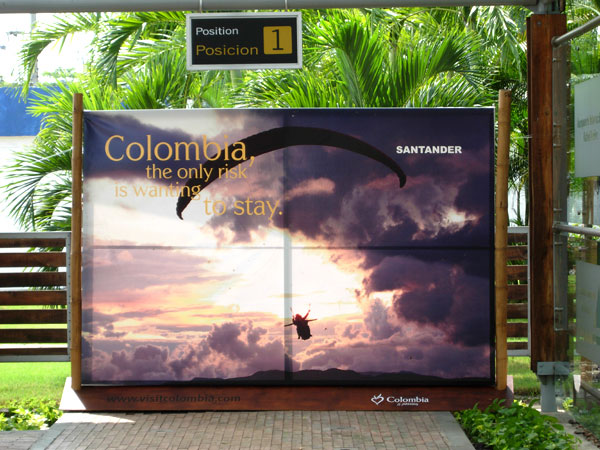
Colombia: the only risk is wanting to stay.

Throughout our travels in South America we had seen this tongue-in-cheek slogan plastered across billboards and the sides of buses. Colombia is working hard to market itself as more of a tropical paradise/purveyor of fine plastic surgery and less of a guerrilla war zone. SOLD!

Sure, traveling by bus at night may still get you shot by FARC (Fuerzas Armadas Revolucionarias de Colombia, the automatic-weapon-toting bullies that prowl the jungle). Sure, there's the occasional car bomb, but people, think about the glorious Caribbean beaches with sand as white as---well, cocaine! Beaches! Boats! Boobs! Butts! This is the new Colombia.


We were cautious travelers for the most part. We only managed one long-haul bus ride while in Colombia and we flew from place to place after that. As two obvious Gringos traveling alone by bus, we received much anxious attention from concerned Colombians. One police officer (after circling my area staring at me for some time) asked me 1. Was I a Colombian? 2. Was I traveling alone? 3.Was my husband Colombian? 4.Was I visiting family here in Colombia? My answers to the negative were met with a slow head shake and a low whistle. Such encouragement was repeated by almost every local person we talked to.

So Colombia's dangerous, huh? Well, in the same way someone with a terminal illness may choose to take up naked motorcycling or drunken hang gliding, we decided to head deep into the jungle on a motorbike-powered wooden cart which ran on railroad tracks.


San Cipriano is an Afro-Colombian settlement inaccessible by road. The residents have rigged up an ingenious mode of transportation using the railroad tracks passing through town. Wooden platforms about the size of a king-sized mattress are furnished with a couple wooden benches and some rail wheels bolted to the underside. A motorcycle parks atop the platform with its back wheel resting on the railroad track. When the driver hits the gas on the cycle, the back wheel powers the whole contraption and it clatters down the tracks, sometimes at speeds of about 40mph. It is awesome.


We were deposited on the side of the highway by a minibus headed for the coast. We knew it was a short walk through a village to the tracks, and we were escorted by a small mob of young moto-railcart drivers all vying for our business (and price-fixing, I might add. This this the other Colombian cartel you don't really hear about). We hopped on a cart with the passing gas can delivery man for a fair price and were soon whisked into the jungle on a rickety cart laden with about 6 jostling cans of natural gas.

The gas man continued to make his regular morning deliveries. One house we stopped at was already bumping off its stilts with salsa beats at ten in the morning. Through the door we glimpsed a bunch of kids dancing in the darkened living room. Jungle boogie indeed.

Eventually we came to the ramshackle village and snapped up a room with commanding views of the train tracks. We then beelined it for the natural reserve for a swim in the crystal clear river.


As we passed through the village, the locals greeted us with a hearty, "Hola Holandes!" Apparently, white people are typically Dutch in these parts, possibly due to the close proximity of the Antilles? We swam. We ate crab coconut milk soup. We saw monkeys and toucans. We weathered a thunderstorm. We passed the evening watching the railroad traffic from our porch. We never once were mugged or kidnapped. However, we were dangerously close to wanting to stay. As a matter of fact, we did stay in Colombia for a few more weeks!


Thursday, July 5, 2012

"Inglewood, always up to no good..."

WHAM-WHAM-WHAM! "LOS ANGELES POLICE! OPEN THE DOOR!" I sit straight up in bed. WHAM-WHAM-WHAM! "L.A.P.D. OPEN UP!" Tara rolls over and lets lose a stinging, "Shhhhhhh!" Seven months of communal living has allowed her to not only sleep through most anything, but to chide those who try to interfere with said sleep.

WHAM-WHAM-WHAM! "WHY ARE YOU STALLING? OPEN THE DOOR! IF YOU DON'T THINK THIS IS THE POLICE I SUGGEST YOU CALL 9-1-1 BECAUSE WE'RE COMING IN!" We're both awake now, wide-eyed, staring in the pitch black towards our door.

We hear a click, a door swing open, and an incredible amount of screaming and profanity as the police corral the people in the room across the hall. The main cop, Officer Dillweed, continues in his monotonous screaming. "IS THAT CRACK COCAINE RIGHT THERE? IF THAT'S RIGHT ON THE TABLE, WHAT WERE YOU HIDING WHILE YOU WEREN'T OPENING THE DOOR FOR US? WHERE DO YOU CURRENTLY RESIDE, SIR. AND YOU MA'AM? THAT DOESN'T SOUND LIKE A RESIDENCE TO ME!"

All I can think about is if the crack-smoking John got a better rate on his room than we did.

Dillweed continues, "YOU THINK I'M ACTING CRAZY? YOU MEAN, YOU DON'T LIKE MY SCREAMING? WELL, LETS JUST SAY I DON'T LIKE HAVING MY WORK INTERFERED WITH! YOU REFUSING TO OPEN YOUR DOOR TO US IS INTERFERING WITH POLICE WORK! THEN, US HAVING TO BANG AND BANG AND SCREAM ON YOUR DOOR AT 3:00 A.M. AND WAKE ALL THESE NICE PEOPLE IN THIS HOTEL FUTHER ADDS TO MY ANXIETY!"

I'm not sure Officer Dillweed was sincere in his calling us "nice." I wonder if I should l play the roll of "concerned neighbor" and inform the John he should quit talking until he gets a lawyer. But I'm getting ahead of myself. Let me back up 6 hours.

South America is over! And I know, dear reader, we still owe you some information on Colombia, but good things come to those who wait.

Anyway we're heading to Vietnam and we planned a 27-hour layover in LAX to meet up with some friends from Bolivia. We booked the lovely Econo Lodge in Inglewood, CA for the night. We catch a taxi from the airport and as we're going down West Century BLVD our cabbie starts telling us how dangerous it is around here. Tara and I look at each other ironically. Every cabbie since Buenos Aires has been warning us about the dangers of walking around at night, etc. It's strange hearing it in English (albeit with a Serbian accent) and it gives the words an added air of truth. He's rattling off horror stories about crazed, violent pimps assaulting pedestrians when he's interrupted by his GPS, "Destination on left."

He looks in the rear view mirror. Gives us a guilty smile and pops the trunk.

Our hotel is very nice. $55. It's very secure. In fact, the owner's desk is in a bulletproof glass bubble. We're on the 3rd floor and our windows have bars on them. I'd never seen bars on windows on a 3rd floor before. We're very impressed. The steel door to our room looks like at had been worked over with a crow bar. But it held, people, it held.

On the way here we'd passed a Burger King. I can stick my head through our window-bars and see it about a half mile down the road. It's been 8 months and during that time the company has changed ownership. I feel partly responsible abandoning them at such a rough time in their existence and feel it my duty to now gorge myself. Only 27 hours in The States, gotta make 'em count.

Tara and I head out at about 10:30 PM. Fireworks are popping off and it's very festive. Oh, it's the 4th of July. U.S.A! We speedwalk down Century BLVD in a strange way. Whenever a street light is out on our side of the street, we cross to the other. Whenever a person approaches we cross again. This road has 7 busy lanes.

We zig-zag our way and make it! The Burger King is locked but the lights are on. A creeeeepy voice says, "You gotta use the drive thru." Who said that? An exploding firework illuminates a figure leaning against a post.

We scurry around back. Yes, now we are behind a Burger King in Inglewood, CA. It's dark back here. We're jumping up and down on the weight sensor so that Burger King's drive thru computer might recognize us as a car. It does not. Speaking into the microphone doesn't seem to work either.

We walk up the window and the man nervously looks out as us. "I can't serve anyone who is on foot in the drive through lane. It's dangerous. You could get hit by a car." I look around with a questioning air as if to imply, "Do we look like the kind of people who are concerned about danger?" I say our orders and he shakes his head walks off. We wait. Miraculously he comes back with food!

There seems to be more people on the way back to the Econo Lodge. After much zig-zagging we make it back and eat the Burger King. But the food has changed, it's different. Apparently the private equity firm that bought Burger King thought that more packaging and lower quality beef would boost sales. Tara comments on how sad it is to see a Whopper in a box, like it's trying to be a Big Mac. Your beauty was in your difference!

It's morning now. In the daylight, looking our our window, I know this to be the most dangerous city we've visited on our trip. However, we had complimentary Eggos and Fruit Loops for breakfast, so it's OK! U.S.A!

Tuesday, June 12, 2012

Black dot, you will always be a sloth to me.

We'd been in the Amazon rain forest for a couple days. We pretty much knew the score. Hammocks, howler monkeys, poisonous everything, fresh water dolphins... trees that can walk... yeah, we got this. But then one morning, on a pre-breakfast canoe trip, something happened.  Something of such mystifying importance occured and I'm still struggling to comprehend its meaning.

The day started as most mornings. We woke up in our thatch-roofed lodge-on-stilts. It's located somewhere deep in the Cuyabeno National Reserve in the badlands along the Ecuador/Colombia border. We grabbed some coffee with the 8 others in our group, put on our ponchos, and hopped into the motorized canoe. We cruised up some tributaries of tributaries of tributaries of the Amazon River and took in the sights and sounds of the jungle waking up.

As we rounded one bend in particular, our guide started. He jumped to his feet was pointing at the jungle. He looked back at us with such a child-like wonder I thought his only logical next move was to scream "cannonball" and jump in the water. But no, he girlishly screamed to the driver to turn the boat around and hold the position.  While the boat maneuvered, he continued his open-mouthed grinning and pointing while looking back and forth between us and the jungle.

We followed suit, squinting to see what he was looking at. The excitement was mounting. On the edges of our seats we peered into the impermeable jungle. We looked back at our guide. He was on his knees, rocking back and forth mumbling something. He appeared to be crying. We let him be for a few minutes and soon he began to compose himself. 

Breathing heavily, he stood, wiped his eyes, pointed to the horizon and with an air of triumph declared, "two-toed sloth." The boat nearly tipped as we lunged to the edge to get a better look. "See there," said our guide, "the tallest tree, furthest away? There's a fork in it and on the right fork there's a bushy branch, see it? There on that branch, you see that black dot? That's the sloth.  See it?"  Oh yes, see it we did.

It was as though the dot was accelerating towards me.  It rapidy grew and expanded in my minds-eye. The moment before it became all encompassing blackness, it kicked me square in the soul and I had to sit. My head hurt. My chest hurt.

As if we needed further convincing of our fortune, the guide was raving about how rare this was and how lucky we all were, himself included. He continued to gesticulate and spew crazy-talk about the infrequency of "dot-, err sloth-sightings."  "Shut up, man! You'll get a tip!" Did I say that out loud? Things were getting hazy. I could barely breathe. Nothing was clear to to me... except... wait... yes, the black dot. It was remarkably clear. In fact, it had morphed into the only point of visibility on an otherwise dark and meaningless world.

Transfixed on the dot I had ceased to breathe entirely. I began to swoon and just before passing out, I looked to Tara and heard her say, "That black dot is the period on the sentence of my life."

I woke some time later to find the boat in a state of panic. Tara was gone and several others were in the water. The guide, seemingly unable to free himself from his shtick was lying on his side and speaking rapidly in French. Scared and confused I demanded answers. The driver, obviously some sort of nihilist, was sitting at his post, looking bored. I grabbed him by his fat head and began screaming in his face. He calmly pulled out his camera. He had managed to take a picture of Tara, mid-transformation, just prior to her grabbing a tree branch and climbing slowly and accurately into the canopy.

Sunday, June 3, 2012

Change in the Weather

We left Bolivia a little depressed. We were unsure why exactly we were leaving. Our sense of purpose seemed to be gone. So comfortable we'd become in our volunteer guesthouse with a routine, friends, and Christian companionship that we'd forgotten a bit how to proceed.  For a month we had put on hold our "desire for discovery" and it was taking some effort to jump-start it again. On top of that, Bolivia's rough-and-tumble way of life had a nagging effect on our spirits. Granted, we lived very comfortably in Bolivia, but our recognition of the shameful social failures and the dog-eat-dog mentality of the culture made for difficult social interactions and had somewhat taken the wind out of our sails. So, a little blue, we headed to Peru.

We'd sensed an uplifting change even on the bus to Peru, but were hesitant to accept it. We saw fewer trash fires, fewer stray dogs, and had bus seats "con extreme confort." We arrived in Arequipa, Peru at night and feeling indifferent, we willfully allowed our taxi driver to take us to his highest commission-paying hostel. It being run-down and attached to a raggaeton-playing discotheque we re-learned why we had always vehemently refused the taxi-driver-hustle. We vowed that tomorrow we'd spur our inner-travellers into action and fell asleep to the "duh-CHIduh-CHI-duh-CHIduh-CHI."

In the morning, we found a much better hostel around the corner, and began walking around. You could almost taste the sea-air in this foot-hills-of-the-Andes town. Surrounded by stunning peaks, manicured parks, and plazas. The people were dressed as though they (or someone close to them) had a decent job. They were not only having conversations but were smiling, laughing, exercising, driving cars, eating homemade cheese ice cream. By-standers would eagerly help us with directions, or pick up something we dropped and cheerfully hand it back to us. Granted, for the first few hours of this, we were on guard for the inevitable hustle. With leery glances we would accept directions. Were they leading us into a robbery? And why didn't that street vendor give us a look of genuine despair when we didn't buy his maracuyas?

It didn't take us long to realize that, yes, in fact, we were in a society that values continual improvement. A community of people who may even have a safety-net. Or perhaps a local juice factory to whom they can sell their overripe maracuyas. Soon, we found ourselves smiling, laughing, and sitting at ease in a public space. Soon, we were the ones eating homemade cheese ice cream.

From Arequipa we headed to Huacachina, Peru. An oasis-town in the middle of the world's largest sand dunes. After the requisite dune-buggy and sandboarding tour we headed to Lima and then back to the Andes to the town of Huaraz, Peru.

We'd been travelling ridiculously fast (42 hours of buses and 4 cities in 8 days - thank you night buses) so we ended up just lying around the hostel for three days acclimating and getting ready for a 4-day hike in the nearby Cordillera Blanca. With 22 peaks over 19,000ft, this 100-miles stretch around Huaraz is home to Peru's highest mountains.

Our hike started just outside of town. We were ahead of the busy tourist season by about a month and, as a result, for the entire hike we saw only three people (two local lenadors and one Californian mountaineer). Up through the valley, we hiked towards breathtaking glaciers, mountains, and altitude. We camped the first night in a grassy bowl facing the way we came. It rained the whole night, but the trusty REI 4-season kept us dry. We woke up to find the coming day's steep ascent mostly snow-dusted. As we climbed, the altitude started to take its toll. The trail was gone, but thankfully our hand-written instructions made the landmarks clear. We hiked above the tree-line, the glacier-fed alpine lakes, and seemingly above the weather system as it began snowing hard from below - the wind carrying the snow up the slope we were hiking. After another hour, it stopped snowing and we arrived at our camp spot.

Our elevation was now 15,400ft and we were completely surrounded by monstrous peaks that were shedding thunderous avalanches into their lakes below. The overwhelming beauty of this epic scene (and the lack of oxygen) floored us and we were perfectly happy lounging by the tent and gorging ourselves on ramen noodles, quinoa, and TVP. Throughout the night it snowed and "iced" every hour. How did we know that it was every hour? Well dear citizen, we knew because our oxygen-deprived brains would not abide slumber. We tossed around with headaches and nausea arose in the morning to a completely frozen tent.


After breaking though the frozen zippers we noticed the clouds had lifted and the avalanches had resumed. The renewed sense of awe (and bizarre exhaustion) resulted in a slow morning. Across a 3-mile scree field we could see the pass we were to take that day and though ti was only 1,000ft higher in elevation, we were in no mood to go for it. We headed down the way we came and were pleasantly surprised to pass though some pre-Incan ruins we managed to miss on the way up. The complex was HUGE, about a kilometer long. We are still unable to fathom how we'd not seen in on the way up. The trail literally goes through it.

After a couple more days of rest in Huaraz, we sold our tent (for more than we paid for it in The States!) to a local tourist-outfitter. Goodbye sweet prince, you will be missed.

We decided to hawk our sleeping pads as well and traveling lighter we headed to the beach-town Mancora, Peru. Tara had a day of surfing, as she is prone to do, and I spent the time just getting sun.

We're now in Ecuador, where it's lush, temperate, and the standard of living is yet more improved. We're happy to announce the return of ale to our diets! It's been since Patagonia and we feel blessed to be back in a place that appreciates the liberal use top-down fermentation, high-alpha hops, and generous amounts of barley malt. Oh, how far we've come in just a few weeks.

Saturday, May 26, 2012

The Arduous Life of a Missionary

I became a nurse because I thought that helping people physically would open the door to helping them spiritually as well. I also became a nurse under the condition that I'd get to work outside (what?). Hey, I was sixteen at the time I decided to be a nurse. I had the romantic image of myself giving injections to skinny little malnourished children in the jungle; that was real nursing! It took me the first three years of my career to find it, but it is nursing... in Bolivia!

Hospital Esperanza is a 25-bed hospital snuggled in at 8000 feet in the foothills of Mt. Tunari in the Bolivian Andes. There's a guesthouse out back, a sprawling one-level affair equipped with front and back verandahs furnished with hammocks, planter boxes of herbs and flowers and a prolific bed of calla lilies. The backyard is the domain of a pair of lovable mutts, and just over the adobe fence there is what appears to be some sort of commercial rose garden operation. Sure, we'll bite the bullet and live here for a month. So our arduous missionary life began.


Having arrived at the end of Bolivian rainy season, we found the yard a jungle of 5-ft tall grasses, sunflowers, and a burgeoning metropolis of wild guinea pigs (also a Peruvian delicacy). Patrick was able to clear quite a swath of it in his time here, uncovering a pack of stray dogs who spent their time napping around the property. In addition to the hospital, there were a few outbuildings scattered around the place, as well as the living quarters for the Bomberos (firefighters) which featured the obligatory soccer field that probably got more use than their fire trucks.

In the morning, I'd jump into some scrubs and head over to the hospital for morning rounds with my fellow volunteers, a couple nurses and a group of PA students. We would follow along with the cloud of interns, nurses, and aides that hovered around each patient, taking turns presenting them to The Doctor. Think chain-of-command, old-time hospital environment where the Length of Your White Coat Matters. It was cool to see; very different than my uber-informal Seattle workplace.

After rounds we'd head back to the house for breakfast. Here's the cast of characters around the table:

Leta- the capable, conscientious, Kansasan. As volunteer supervisor, she was responsible for organizing the many details, big and small, of what makes this place go. So what if it gives her hives? She has the singing voice of a Disney princess.

Shelly- A bright and funny nurse from Colorado. Drank yogurt like coffee. Her heart is in Plaza San Sebastian.

Rachel- An exuberant Mountain guide-turned-nurse from my own Seattle. College buddy of Shelly. Famous for her mustard salads. Her heart is also in Plaza San Sebastian

Breanna- alias "Breannita" (because at one point she was the younger of two Breannas here) In Bolivia for several months, aspires to live 'in the ghetto' and work with kids back in Prince George, Canada, her home sweeeet home (like the song?). Has a thing for Reese's PB cups.

Miranda- buddy of Breannita and fellow Prince Georger, studying medicine. Nikon SLR always at the ready.

These were the permanent players. We got a new shot of life when different volunteer groups cycled through, but these were the people we spent the most time with and had the most laughs with. Seriously, such a remarkable group of women! Patrick barely minded he was the lone male, or "house-Dad," for most of his time here.

After breakfast we medical-types would take the scenic 15-minute walk to the nearby village to do some physical exams at the school. All of us "doctoritas" walking into the playground and setting up our clinic under a chirimoya tree caused quite the stir during recess. We found ourselves mobbed with children braiding our hair, asking us questions, begging for toothpaste & toothbrushes. Eventually we'd establish some order and we actually found that some of the kids there were darn sick. April is flu season in Bolivia, and of course you have to think about things like parasites, Dengue fever and Chagas disease (a.k.a. African sleeping sickness), diseases I always gave as much effort to learning about as bubonic plague: "Oh yeah, they're bad, I'll never see them..." Hah! Our bread and butter in Bolivia.

In the afternoons we might visit an orphanage for a couple hours to help out, do check-ups or play with the kids. Some days we'd do another free clinic in a different village. Sometimes we had down time and Patrick and I would walk the dogs, one of whom was recovering from a broken leg (car vs. dog, the hospital traumatologist had made him a doggy-body cast at one point). Throughout the village and surrounding countryside, we were a hilarious spectacle for the locals who stared and laughed at the gringos with dogs on a leash! They seemed to think dogs were more like rock-magnets than pets. We saw a couple Cholitas (usually feisty women in the traditional garb of Bolivia) chuck rocks at mongrels with laser accuracy. When mobbed by strays on our little excursions, Patrick and I only had to mime a throwing motion and those dogs were outta there.

Fridays were pretty much dedicated to going to the Plaza San Sebastian to work with the glue-sniffers. In the morning we'd prep their lunch, do a Bible study, then work in the plaza in the afternoon. We'd treat wounds and other problems, give them lunch, read from the Bible, pray with 'em, and just chat with them. It was really hard working with these guys, because they're usually high and you were never sure if you're getting though to them. the idea is, treat them with love and respect (no one else really does) and let the healing love of Christ do its work. Fortunately, Rachel and Shelly are really passionate about long-term work with this group. Their eventual goal is to open a women's shelter to help them transition from street to society.

Saturday's activities were considerably lighter: Kid-washing! Another org. from the states actually sets up a couple tents in the main plaza in Cochabamba, and they bathe street kids ages 6 and under. We got a sort of assembly line going, usually their mothers were there helping, and we'd strip'em, scrub 'em, dry 'em, dress 'em, and braid 'em (if girls). I learned that I am painfully inept at braiding girls' hair, especially Bolivian girls whose braiding standards are astronomically high, given that their mothers wear about 2 meters of immaculate braids which are carefully re-strung daily. After the kid-wash we'd meet up with Patrick and maybe sample some street food at our favorite place.

We had so much fun in our little guesthouse community; we hiked in the mountains together, played Wally (the world's best game; eat your heart out, volleyball), hung out with our Bolivian buddies, celebrated birthdays, even had a Bolivian prom for Breanna, who missed hers back home. It was so nice cooking and eating together, praying and reading and singing together. It was really encouraging living with Christians again, especially fun ones, in such a joyful house.